



Originally published October 2020, updated August 2026
Adversity can often be a catalyst for positive change. For Talia and Luke Borda, founders of That Red House, a second cancer diagnosis led to a new business distributing a natural laundry product which changed their lives and many others around the world.

The Story Behind That Red House
In 2002, Luke was diagnosed with cancer and, after undergoing seemingly successful treatment, his second diagnosis in 2006 confirmed their ultimate fears. In a bid to improve their health, Talia began researching chemicals and ways they could reduce their chemical exposure by switching to organic food and using toxin free products.
“I was horrified to discover the extent of what we were unknowingly exposing ourselves to every day,” Talia recalls.
After a few years of living their new lifestyle and the birth of their second baby, Talia and Luke took their sustainable pursuits one step further. They sold their house in the leafy eastern suburbs and began the process of building an eco-house and sustainable organic produce garden in the Adelaide Hills.

How Talia Discovered Organic Soapberries
But with this new organic lifestyle, Talia was struggling to find an organic and grey water safe option for the laundry that allowed them to safely use the water on the vegetable garden. She needed a 100 per cent chemical free, biodegradable and preferably organic detergent that actually worked on three dirty little boys.
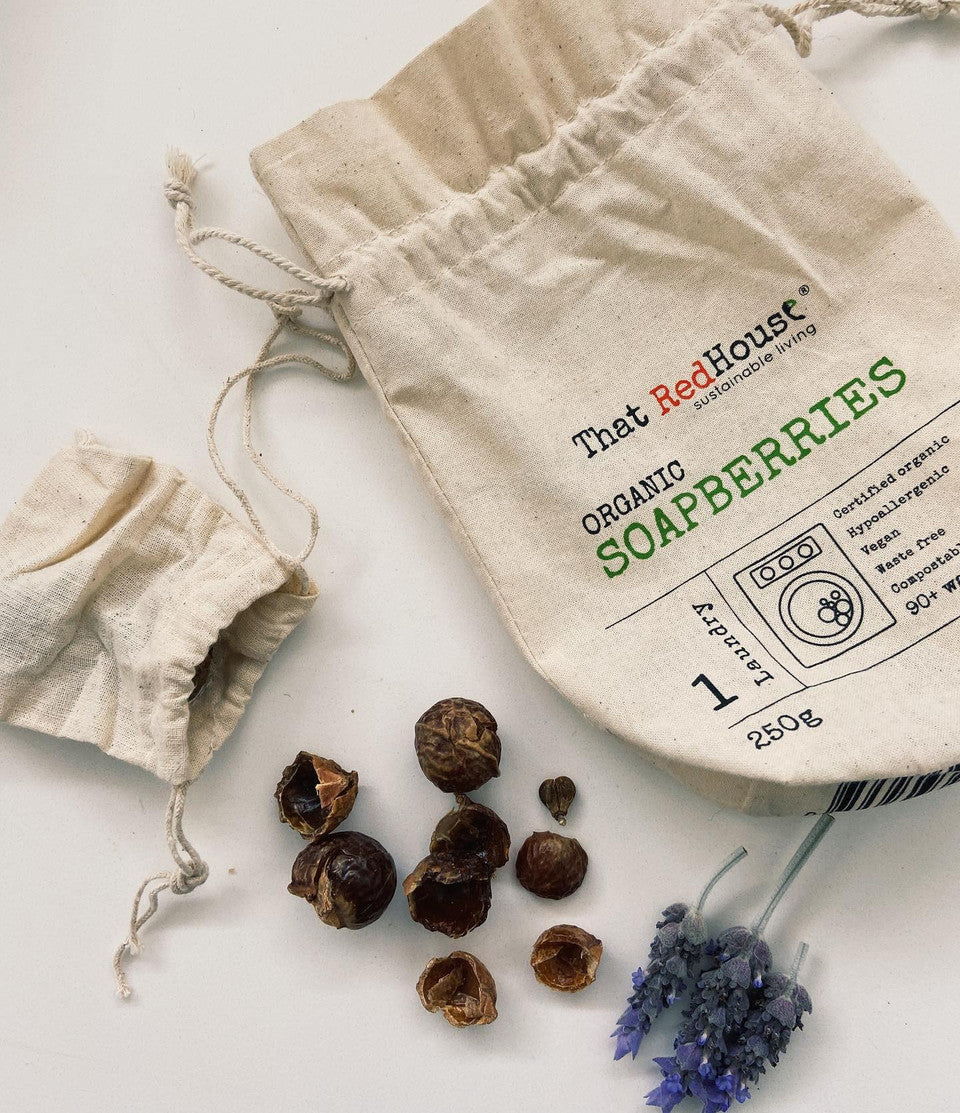
After much research, Talia discovered soapberries, the fruit of the Sapindus mukorossi tree, native to Nepal.
Soapberries contain a substance called saponin in the pericarp, or flesh, of the fruit, which acts as a natural soap. They have been used for thousands of years throughout the Himalayas for a multitude of purposes.
To harvest the berries, the trees are climbed manually and the berries are picked by hand by local communities native to the area. They are then harvested, dried in the sun, deseeded and packed. No chemicals are used at any stage of the process; they are 100 per cent certified organic and completely raw.
Wondering what you can do with them? Read our complete guide to using soap berries for laundry and cleaning around the home.
From Soapberries to That Red House
After using soapberries for a few years, in 2013 Talia and Luke decided to take the plunge and start their business, That Red House. They imported around 600 kilograms of soapberries, which quickly sold out.
It became clear that people were ready to embrace the idea of a completely natural way to clean their clothes and were becoming wise to the chemicals used in mainstream detergents and cleaning products.
“I discovered them, loved them and decided that the world needed to learn about my little secret too,” Talia said.
Now Talia and Luke distribute That Red House Organic Soapberries throughout Australia and to New Zealand, Asia, Mexico, Bermuda and Europe. They have expanded the range to include solid laundry and dishwashing soaps, as well as laundry tonics made from 100 per cent pure essential oils, which can be added to the soapberries for fragrance.
“Our aim at That Red House has always been to strive for a sustainable, organic, eco-conscious, zero-waste, chemical free way of life. This supports our desire to maintain the health of our loved ones and the planet which can never be replaced.”
Discover That Red House at Biome
Explore organic soapberries, natural laundry soaps, dishwashing soaps and pure essential-oil laundry tonics from That Red House.
Shop That Red House soapberries and natural laundry products →
Related Reads
How to Use Soap Berries: 7 Natural Uses for Laundry and Cleaning
How to Make Soap Nut Dishwashing Liquid: DIY Recipe
6 Ways to Wash Clothes Without Plastic and Harmful Ingredients